Health is more than the calories you consume and burn. This health blog is about fitness and nutrition, as well as philosophy and humor for a holistic approach to living well.
What’s the strangest beer you’ve tried? Green beer on St.
Patty’s Day? An imported beer from Mexico? Or maybe you found yourself drinking
the Clamato-Budweiser on a dare?
Seafood, tomatoes and beer... I can't see how this could go wrong...
Whatever the case, I’m sure you had a lip-smacking
good time. But, working in a restaurant that prides itself on its extensive 99
different stocked beers, I’ve come across some strange brews. I’ve decided to
include a list below of the most notable ones with a link in case you’re
feeling daring. I have nothing against Bud Light, but sometimes it’s good to
step outside your comfort zone.
Spicy Beer
Everyone knows of the dreaded monster that can accompany a
night of drinking. If the Tooth Fairy shows up at night and leaves you money
for teeth, the Beer Fairy leaves a different present in your digestive tract.
That’s why Cave Creek Chili Beer seems like such a dangerous idea. Sold at my
restaurant, Cave Creek has pieces of chili pepper in every bottle. I made the
mistake of eating a dried chili pepper once – it was included as a garnish on a
plate of tacos. Thinking that the restaurant would never put a “real” pepper on
my plate, I chowed down.
There wasn’t enough water in the world that night.
Super Beer
A typical bottle of beer ranges between four to six percent
alcohol. But Sam Adams Utopias are 50 proof bottles of beer – 25 percent
alcohol. Instead of a nice, pourable (or chug-able, depending on your preference)
beer, Utopia is very thick and tastes like vanilla. It's more of a port than a beer. Best to sip this one –
pacing yourself is tricky with a beer five times more potent than usual.
I love how this stuff comes in a chalice that rivals the Holy Grail
Breakfast Beer
Bacon is a breakfast staple. And why shouldn’t it be? Crispy
or floppy, thick or thin, savory or sweet, bacon in its infinite forms never
fails to be delicious. I’m sure this line of logic is what caused some beer-wizard
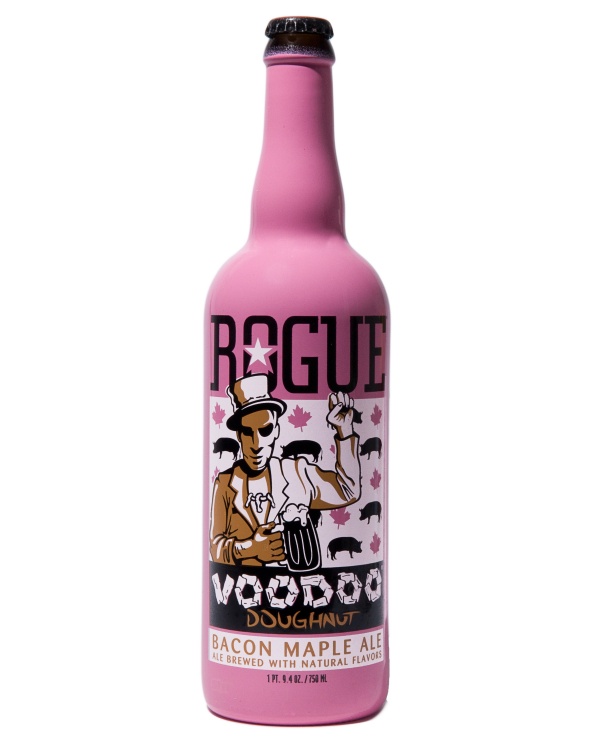
to try fermenting bacon. But was that enough? Oh no. The geniuses at the Rogue
label have created a Doughnut Bacon Maple Ale – all the taste of breakfast in a
single bottle.
If you can get past the fact that it looks like a glass
bottle of Pepto-Bismol, the only thing left to work past is the taste.
Pizza Beer
Pizza is one of those foods I could eat twelve times in a
row and still not be sick of it. The hardest part of any diet I’ve tried is
avoiding pizza. But here’s a twist – a home brewery in Campton Township,
Illinois, fermented garlic, tomatoes, and herbs to create a beer that tastes
like pizza. And that's the story of Mamma Mia! Pizza Beer.
Despite my deep and nearly disturbing love for pizza, I’m
going to have to pass on this one.
Hey everyone! I'm sorry for my lengthy absence this week - I've been in New Jersey. I wanted to post this yesterday, but after a marathon 12 hour drive from the east coast back to Michigan, I could only manage a quick shower before passing out. Fortunately, my time spent on the beaches of New Jersey inspired a topic for this week: beer!
Today I will talk about the way beer works in our bodies. My upcoming posts will likely cover some bizarre beer from around the globe, and the history of alcohol.
"Proof That We Were Meant to Be Happy"
I remember drinking a Bug Light in front of my cousin, Alex. He didn't understand how I could drink something that "tastes so bad."
I smiled, "Well, no one really likes the taste at first. But after two or three, you stop noticing."
Truth be told, although I do fancy an occasional beer, I am not a recreational drinker. My tolerance for alcohol is pathetic. One beer gets me tipsy, two gets me silly, and anything beyond that becomes hard to remember the next morning. I can count on one hand the times I've drank to excess, and it would only take that same hand to count the number of times I've been hungover. And I refuse to touch the wheel of a car if I've had anything to drink.
But now that I've made my "responsibility disclaimer," I will admit to liking the taste of beer. There's a marked difference between a rich stout and a wholesome ale. I won't pretend to know the different types of beer or what goes into a beer that gives it such diverse flavor, but I do know a bit about how it affects the body.
First Stop: The Stomach
Over the lip and through the gums... You know the rest. Your stomach is the first gateway for dealing with alcohol. It boots the majority of your booze to your blood, but it can move a small portion to other places. For instance, about ten percent of the alcohol you drink will come out through your sweat or breath. This is why you can smell when people have been drinking heavily and why a breath-alyzer can determine your Blood Alcohol Content (BAC) level.
Think of your brain cells as teenaged girls. Their whole lives revolve around calling or texting friends on their cellphones. With good service, very few (if any) messages are lost. However, when alcohol is introduced, signal strength between cell phones becomes weaker. Messages sent by one girl get lost before making it to another. Between teenaged girls, losing a text or a call can be frustrating, but in the brain, losing signals between neurons can have bigger reprecussions.
"Omigod, like, Sarah Bellum is totally NOT answering my texts!"
The Hippocampus controls our memories. Depressing the hippocampus can make it difficult to remember recent things, or worse, can cause temporary blackouts.
The Cerebral Cortex controls our senses and inhibitory centers. Disturbances in this part of the brain make us more talkative, confident, and daring. However, it also makes us more prone to making poor or dangerous decisions.
The Frontal Lobe controls our thought patterns and decision-making abilities. Alcohol impairs these functions, making us more likely to act without thinking. It can also make emotions much harder to control.
The Cerebellum controls our balance and awareness. A drunk cerebellum causes us to be uncoordinated and confused.
Alcohol enters your bloodstream right from the start, which is why you can start feeling tipsy minutes after a drink.
Third Stop: The Liver
Your liver is the processing plant for most of your body. Some of your organs perform more specialized processing, like your kidneys handling cholesterol. But your liver filters most substances in your blood - including alcohol.
Upon reaching your liver, ethanol, the stuff in beer that gets us drunk, breaks down into less potent compounds. Although your liver is constantly filtering your blood, it takes the liver about an hour to process 12 ounces of beer (the same amount of time is needed for one glass of wine or one ounce of hard liquor.) Until your BAC drops, your brain will continue to lose signals between neurons, creating a feeling of drunkeness.
Last Stop: The Bathroom
Once the alcohol has been processed, it exits the body through the bladder. Because alcohol is a dieuretic, it takes a lot of water with it. This is why it's important to re-hydrate after a night of drinking to be sure you won't spend the next day with a splitting headache.
Well... HOPEFULLY it exits through your bladder...
But Wait! I Like Beer!
Drinking seems pretty bad when I list all of the effects like that. And while it's true that going overboard with alcohol can be very bad, studies have shown that moderate drinking might be beneficial for health.
Finishing up this week, I will talk about the history of soccer. For anyone reading this outside of the United States, this will be a history of football. But like a typical American, I will remain dead-set in my ways and refer to it as "soccer" throughout the post. I'm sorry for any confusion.
Ancient Greek Origin
Soccer, like marathons and the Olympics, also started in Greece! In fact, it comes from two sports called Episkyros and Harpastron.
Episkyro had 12 players on either side and took up the length of a modern soccer field. Episkyros (meaning "commonball") was around as early as 800 B.C.E. and allowed for the use of hands as well as feet. The goal was to maneuver the ball behind the opponent's line (similar to soccer.) The offense could kick, throw, or carry the ball, and the defense was allowed to stop the offense by any means necessary. Full-on tackles, punching, tripping and headbutting were allowed. Players sometimes died during the game.
When the Romans conquered Greece in 146 B.C.E., they took two sports and merged them together to form Harpastum. Harpastum had no set player limit - some games were reported to have hundreds of players on either side! Hands and feet were allowed, but so was an ultra-violent defense. It was to a player's benefit to use their legs to get rid of the ball as quickly as possible, or risk being torn apart like a bag of Doritos at a Motley Crue concert.
Harpastum was always played on field or sand because the players expected to be thrashed.
If you don't believe me when I say that Harpastum was violent, watch this video. It's in Spanish, so I'm not sure what they're saying.
It looks more like a scene from Martin Scorsese's "Gangs of New York" than a sport!
This makes me think about people who complain about American Football being too violent. Compared to these guys busting each others' heads open without pads, American Football might as well be a televised pillow fight.
My girlfriend's mom is going to run in the Chicago marathon this October. I shudder at what it takes to complete one. A 150 pound person would need 2950 Calories to run a marathon. That's five Big Macs worth of chemical energy, and if you weigh more than 150 pounds, the amount of required energy increases. Although I have the mental fortitude to watch all three Lord of the Rings movies without stopping, I don't have it in me to run 26 miles. So, I really do wish her the best of luck, and I can't wait for all her training to pay off.
Marathons, like the Olympic games, have an interesting history tied into Greek mythology. It's not as cool as Hercules setting up a tournament to honor the King of Olympus, but it has a certain Hollywood charm.
The Myth of Pheidippides
Don't worry - I can't pronounce that name either.
According to legend, Hippias, the former tyrant of Athens, sought to take back his kingdom in 492 B.C.E. For sanity's sake, I'll try to avoid the dry details. The important point is when he landed on the shore of Marathon, the Athenians wiped the floor with him and his army.
They then sent a runner to Athens to spread the news. The runner, a soldier named Pheidippides, ran 24 miles on foot to the city of Athens, shouted, "Victory!" and then fell and died from exhaustion. In his honor, the man who carried the news of Athens' glory to his dying breath, the Athenians hosted an annual, commemorative 24 mile footrace.
See the Hollywood in that?
The Facts of Pheidippides
As neat a story as that is, it's in no way true. Although recorded in Plutarch's The Glory of Athens, that story was written 550 yeas after the time Pheidippides was supposedly alive. On the other hand, Herodotus' Histories was written just 50 years after the time of Pheidippides, and Herodotus wrote something a little different.
Hero (short for Herodotus because I'm getting sick of typing these long Greek names, over and over again,) wrote about a long-distance runner sent from the Athenian army to Sparta to ask for reinforcement. On his way to Sparta, the runner, Phei (again, his name is too long,) encountered Pan, a Greek god. Pan asked why the Spartans weren't worshipping him anymore. Phei finished his run to Sparta, didn't die and told the Spartans to support the Athenians and to worship Pan. They agreed, and with the god Pan on their side, they defeated the tyrant Hippias at Marathon, and hosted the Marathon run in honor of the god, not Phei.
Yep, Pan is a satyr. What is it with Greek athletics and goat-men?
While this story seems a bit more complicated, it has one thing going for it: in the original myth, Phei was sent after the Athenian victory at Marathon. If the battle had been won, why not send a horseman to Sparta? Why send a runner such a long distance? The only reason you'd hold a cavalryman back is if you still had a battle to fight, which makes the second story not only more time-congruent, but also plausible.
Modern Day
But wait, aren't modern marathons 26 miles long... What's this business about 24 miles? The distance from Marathon to Athens is 24 miles. The original marathon ran in honor of Pan was that same distance. The marathon was later adapted to the first modern Olympic games in 1896, hosted in Greece, remaining the 24 mile distance.
The extra two miles were added in 1908 when the Olympics were hosted in London. The distance was added so the race would go from Windsor Castle to White City Stadium.
Since 1908, 26 miles have been the standard distance for marathons.
God save the queen... Right?
I'm sure my girlfriend's mom will be happy about those extra two miles...
This week, I'm focusing on the histories of three prominent sporting events: the Olympics, marathons and soccer (or "football," if you live anywhere other than the United States.) Surprisingly, all three have ties to ancient Greece! If you're wondering what this has to do with health, I'll admit, it's a bit of a stretch. But when you hear about how brutal some of these events used to be, I'm sure you'll agree that the men and women who competed were certainly some of the strongest, bravest and healthiest humans alive.
If you're like me, you're quick to doubt a story. People like me constantly ruin movies by pointing out errors that most people don't care enough about to notice. I'm the guy who wonders how Jeff Goldblum created a computer virus for an alien programming language in Independence Day (1996), how John Hammond re-created prehistoric plant life from mosquitos (which might have sucked on dinosaurs, but certainly not on flowers,) in Jurassic Park (1993), and how humans and Vulcans had similar enough DNA to have a child (Mr. Spock,) even though they're not of the same species, planet or galaxy in Star Trek?
Yes, I should have more important to think about. No, I am not ashamed.
So, if you're like me, and you were told the history of the Olympics was centered around Hercules, the ancient Greek hero, you'd probably call "BS."
But there's some truth to this idea...
Hercules - An Abridged History
If you want to learn more about Hercules, I invite you to read Library of World History by Diodorus of Sicily. Or, you can read all you need to know within three paragraphs from me. Your choice. No pressure.
Hercules is actually the Roman spelling of the Greek hero, Herakles. Herakles, son of Zeus, was the Greek equivalent of Superman - he was tall, handsome, impossibly strong and practically indestructable. You might have seen the terrible Disney adaptation that features a satyr voiced by Danny DeVito - that's not the story of Herakles, that's just Disney making money.
Sorry Danny, but Hercules was trained by a centaur, NOT a satyr.
The story of Herakles is that of a demi-god (half-god) who killed his wife and children because he wasn't allowed to be king. In order to make up for his crime, he was appointed twelve tasks, better known as the Twelve Labors of Herakles. The first ones were easy - strangle a lion, kill a hydra, capture a boar, etc. All in a day's work, really. After that it got tricky - Herakles had to kill an army of Amazons for a belt, hold up the Earth for some golden apples, and bring Cerberus, the three-headed dog of the Underworld, back up to the surface. He succeeded (as heroes often do,) and earned his place among the gods. His ascension from mortal to immortal is what makes Herakles a universal mythological tale.
The history of ancient Greece is interwoven with its mythology, making the "truth" very messy. Was Herakles a real person? Probably. Was he superhuman? Probably not. Most kings and ancient rulers were seen as having a touch of the divine, so many stories written about their deeds include godly intervention. The myth says after Herakles completed his Fifth Trial, he hosted a series of games in honor of his father, Zeus. The games included boxing, chariot racing, pankration (MMA for ancient Greece,) pentathlon (discus, javelin, long jump, running and wrestling,) running and wrestling. The myth also has it that Herakles measured out the running track by 600 paces. Using math, historians have measured the length of the ancient Athens track and found that Herakles would have had a size 13 foot and would have been over six feet tall.
The Olympics
The Olympics were the games that Herakles created in honor of his father, Zeus. Hosted in the city of Olympia (it's namesake,) the games have a history starting in 776 B.C.E.
Every four years, the city-states of Greece would send champions to Olympia to compete in the games for the honor of their lands (sound familiar?) The competing city-states included Sparta, Athens, Corinth, Argos and Megara. Although these lands were consistently at war, the games were a place for temporary peace - no killing your fellow competitors! The winners of the games were said to be "favored by the gods," implying that their homeland was also favored. This often led to new wars breaking out.
Men are from Mars, women are from Venus. That's as cliche as it gets for gender differences - the idea that men and women are raised so differently that they could be considered separate species from separate planets.
I'd prefer to be from Neptune, but Mars is cool, too.
In a lot of ways that's true. Just as my girlfriend can't get me to keep all my laundry in a hamper, I can't get her to understand that the floor is the biggest (and most under-utilized) storage space in any home. Still, there's common ground. We both like action movies, we both put on our pants one leg at a time (I tried doing both at once - it's overrated,) and we both believe that Saturday morning cartoons are the cornerstone for happiness.
That, and we're both the same biologically, right?
Wrong. It turns out that men and women vary in more ways medically than originally assumed. Years of focusing on what effects drugs might have on men (particularly middle-aged, white men,) has kept us behind on studying effects for women or minorities. The logic was that if it works for one human, it would work the same for all. But the truth, sad to say, is that the cliche still holds - Men prefer Motrin and women prefer opiates.
Pain and Relief
Studies have shown that women are more likely to report when they feel pain than men. Women will also report higher pain scores (on a one to ten scale) than men with the same condition. This suggests that pain tolerance could be social. Maybe we teach girls that it's okay to admit when something hurts. Or, on the other side, maybe it's the boys we're teaching to tough it out. Both sound right to me, but there hasn't been any conclusive studies to link medical pain-reports to the raising of children.
Although not medically tested, Mom's kisses are the best treatment for boo-boos and owies.
The differences of gender continue at a pharmaceutical level. Although male and female bodies go through the same steps to metabolize drugs, subtle differences in our bodies change the efficacy of certain drugs. For instance, due to their fluctuating levels of hormones, drug concentrations in the blood stream change by the day even if the dose is kept consistent. Also, because women have a higher percentage of body fat than men, medicines that store in fat stay in the body longer, meaning that less should be taken.
Ibuprofen, one of the most commonly prescribed painkillers in America, is more effective in men than in women. But that's not the only drug being noticed for treating the sexes differently. One commonly quoted study showed that one pain reliever (an opiod) prescribed to men and women after dental surgery caused an increase in pain for men and a decrease for women.
So what does this mean? Will pills eventually come in "his" and "hers?" Possibly. What's important is that these questions are being asked.
(Personal note: I'm sorry this post is a day late. I've been making routine trips to Urgent Care these past few days, so finding time to write has been hard. But here it is!)
Today's post will give you the basic guidelines for some life-saving techniques. After all, who hasn't wanted to be a hero?
CPR: Or, How To Get the Lifeguard to Kiss You
We've all heard a corny "mouth-to-mouth" pick-up line before. CPR has been a comedy goldmine for many years. But what is it and how does it work?
CPR stands for Cardio-Pulmonary Resuscitation. In normal-people speak, CPR is how we restart (resuscitate) someone's heart (cardio) and lungs (pulmonary). Think of the heart and lungs like a Swiss watch. Normally, the heart beats at a steady pace and the lungs inflate and deflate without us thinking about them. Every minute of every day that you've been alive, your heart and lungs have been there for you.
If only ALL watches were so reliable...
But what happens if you forget to keep your mouth closed while diving into the swimming pool? Your lungs fill with water and everything stalls. CPR manually pumps the heart and, when combined with rescue breathing, keeps oxygen and blood flowing throughout the body. It restarts your organs, causing you to spit up the chlorinated water. And hopefully, if your hero was good-looking, then you've got a nice story to tell as well.
When and How to Do It
There are signs to look for before administering CPR on someone. For instance,
This student does not need CPR. He is sleeping.
CPR is used on anyone whose heart has stopped beating, whether from heart attack, drowning, or smoke inhalation. First, check to see if they're breathing and if their pulse is normal. If they're not, you've got to act quick. If they are, then they're probably sleeping like the student above, and CPR is unnecessary.
Second, call for help. You're probably not a doctor or paramedic, so it's good to get someone there who is.
Third, start chest compressions. This will keep the person's heart beating, which is a priority. Lace your fingers together and put the heels of your hands against the center of the victim's chest. Press down through your elbows, hard, and wait for their chest to rise before pushing down again.
They say that 100 beats per minute is the best rhythm for CPR. Ironically, the Bee Gee's song, Stayin' Alive, is also 100 beats per minute. So hum a little disco to yourself to keep the right pace.
If you're not comfortable giving mouth-to-mouth, or you're not properly trained to do so, continue steady chest compressions until help arrives.
And it's as simple as that. Congratulations, hero, you might have just helped save a life.
Warning
In the heat of the moment, you might be tempted to push too hard. CPR has been linked to rib injuries, espcially in the elderly. Some bruises are a small price to pay for returning from the dead, but still, be mindful of just how hard you're pressing.
The Heimlich Maneuver: Or, The Bear-Hug of Life
The Heimlich Maneuver is another popular first aid technique. Although it's not made fun of as much as CPR, there's still some comedy to be found. For instance, the Heimlich Maneuver helps someone who is choking by forcing the object out of their throat. The irony here is that it's hard to say "heimlich" in a German accent without spitting.
Unlike CPR which can be used in a variety of circumstances where the heart has stopped, the Heimlich Maneuver is only used when someone has an object in their windpipe and cannot breathe.
How You Do It
First, check to see if the person is coughing. If they are, that means their airway isn't completely blocked and they could correct the problem themselves. If they're not, position yourself behind the choking victim. It would be nice of you to tell them what you're doing before the next part, or else they might get some funny ideas.
Second, make a fist with one hand and place it between their belly-button and their ribcage. Cover that fist with your other hand. You should now be hugging them from behind. See why that introduction was important?
"Hello! I'll be the one saving your life today."
Third, in one swift movement, press your first inward and upward into their gut. Don't be afraid to lift them off the ground a bit if that's what it takes. For the victim, this can be an incredibly painful procedure, so it's best to get it done as quickly as possible.
Continue the sharp pulls to the stomach until the object in the throat has become dislodged. Take a break after every five compressions to check the person's mouth - if the object is visible, pulling it out would be better than squeezing them again.
What you've done is you've squeezed (squozen?) the choking victim's diapgrahm - it's a shelf of muscle in the gut that controls deep breathing. By pressing into it, you force air through the lungs and up the windpipe. If you'd prefer an analogy: the windpipe is a straw and the lodged object is a spitball. Only by putting enough air pressure behind that wad of paper will it fly out.
Warning
Just like with CPR, the Heimlich Maneuver can be very damaging. Aside from inducing vomiting, the maneuver can also crack ribs and bruise internal organs.Always have a choking victim go to the hospital after the administration of the Heimlich Maneuver.
Get Certified, Be a Hero
Nothing makes you feel quite as cool as having a card in your wallet that says, "I know how to save lives." Even though that's not what a certificate of first aid actually says, spending some time learning these techniques from officials could very well mean the difference between life and death. If you're curious where you can take first aid classes in your neighborhood, check out the Red Cross website.